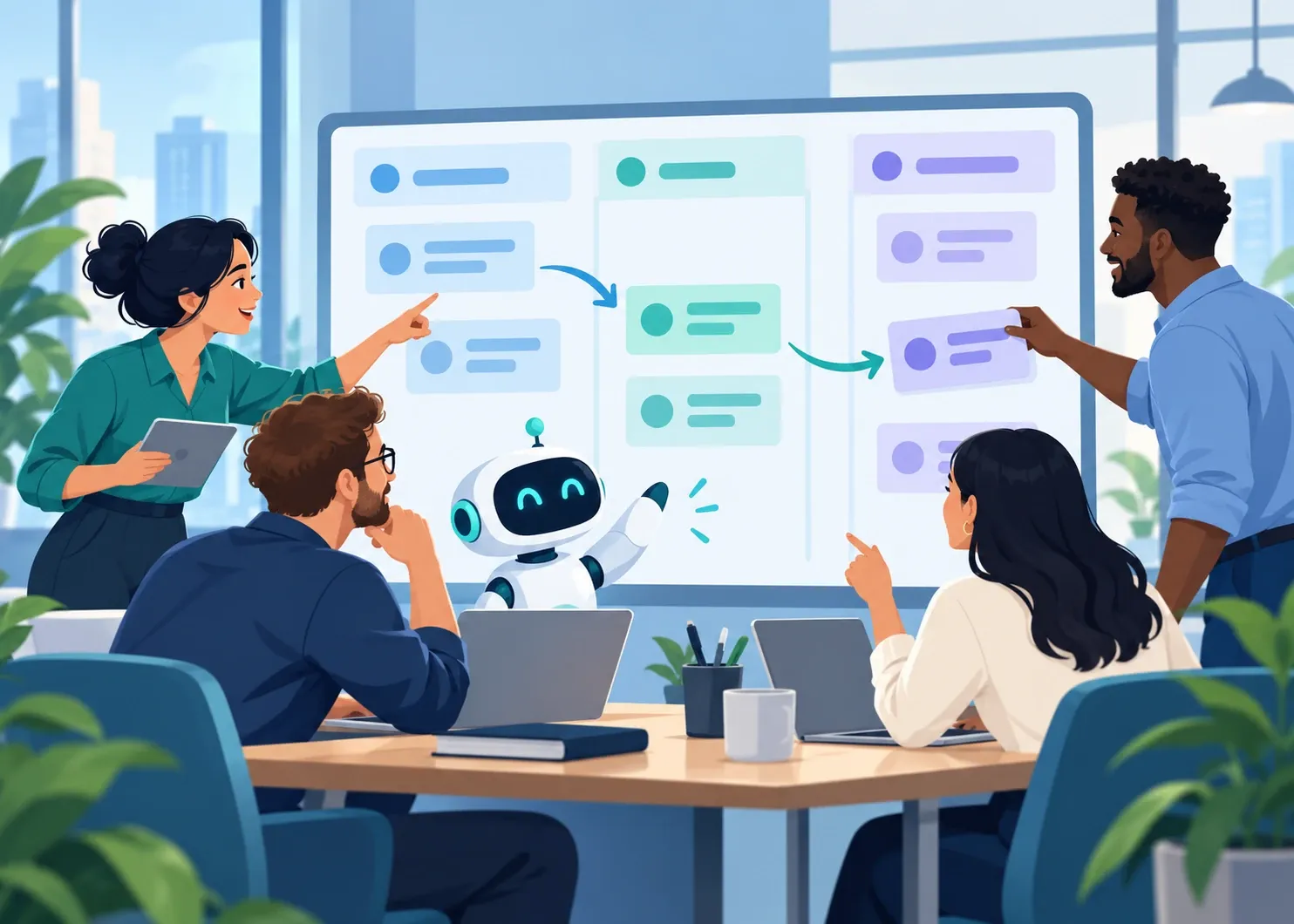
Key takeaways
- Start with the task and its owner.
- A service employee may use AI to find an approved answer or draft a reply.
- Measure prompting, reviewing, correcting, and filing.
How can AI make everyday business tasks easier for a team? It can prepare a first draft, summarize a long note, or suggest how to group requests. The useful design keeps an employee responsible for accuracy and places the approved result in the team’s existing workflow. Otherwise a new tool can add more work than it saves.
Organize everyday work around outcomes
Start with the task and its owner. For meeting follow-ups, the result should be a confirmed action list with names and dates, not merely a polished summary. Ask the assistant to flag unclear ownership, then resolve it with the people involved. Store the approved list where everyone already looks.
Help staff with routine tasks
A service employee may use AI to find an approved answer or draft a reply. An operations coordinator may summarize a request before routing it. Give staff examples of acceptable inputs and outputs, and a quick way to correct mistakes. Do not ask them to trust unsupported suggestions.
Reduce time spent on admin without shifting it
Measure prompting, reviewing, correcting, and filing. Include the receiving colleague in the assessment: a shorter handoff that omits context may cause more follow-up. Use ordinary rules for predictable reminders and AI only where interpreting variable text adds value.
Make the practice repeatable
Set a shared standard for approved tools, data handling, review, and escalation. Name someone to update source information. Invite staff to report failure cases. Expand only when the whole task becomes clearer and easier for the team.
A practical next step
Choose one handoff that regularly creates extra messages. Test a reviewed AI-assisted summary and ask the next person whether they could act on it.
Explore our AI services or contact our team when you are ready to turn the idea into a scoped project.
Frequently asked questions
Will AI replace team coordination?
No. It can prepare information, but people still need to agree on priorities, owners, and commitments.
How should staff check an output?
Compare it with the source, verify important details, and route uncertain cases to the responsible person.