



Key takeaways
- Redesign the end-to-end workflow and its decisions; adding AI to one task often moves the bottleneck elsewhere.
- Allocate work by capability, consequence, uncertainty, and reversibility rather than by a goal of maximum automation.
- Embed evaluation, permissions, escalation, monitoring, and user feedback directly into the operating flow.
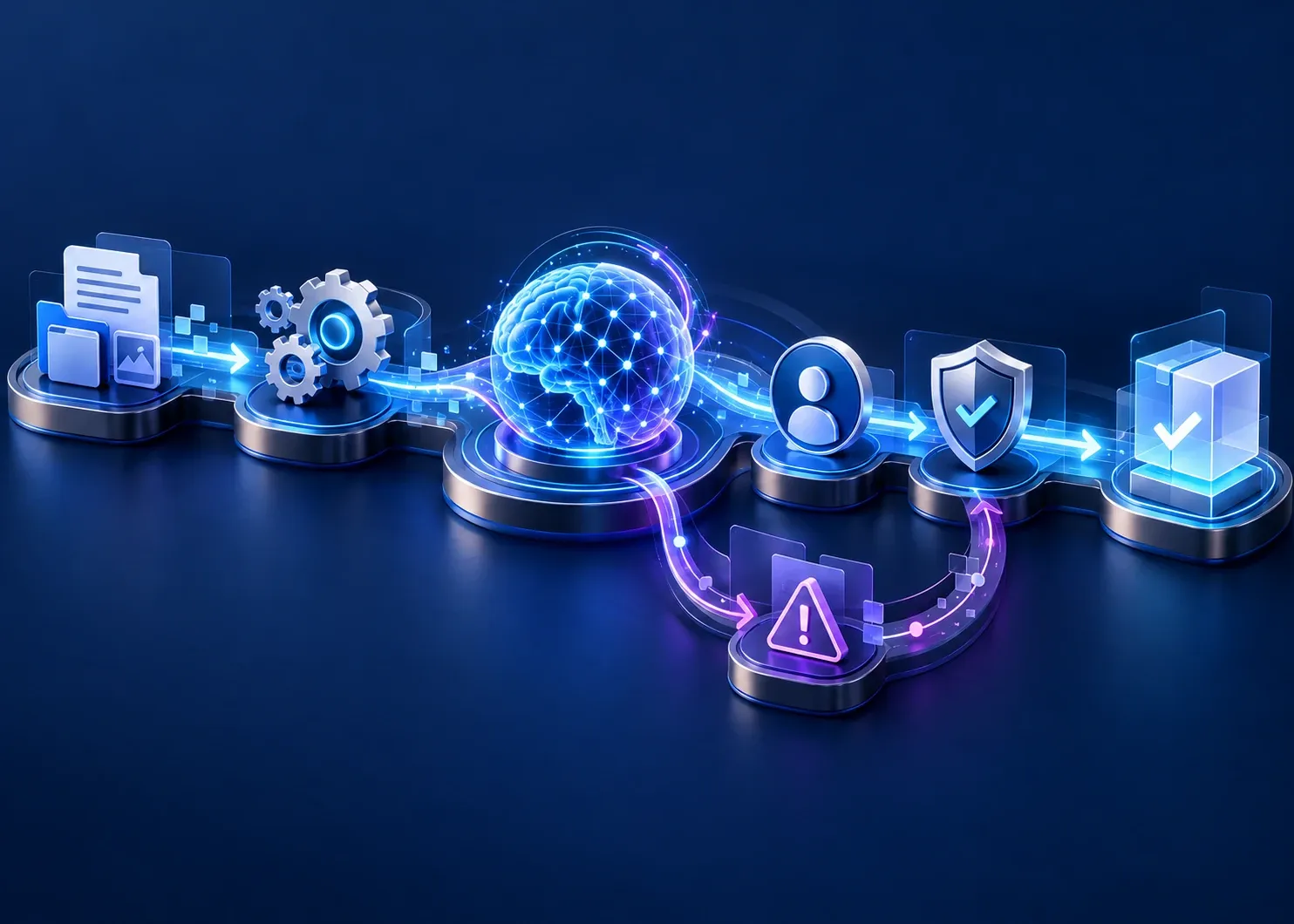
AI business transformation redesigns how work moves from demand to outcome. Instead of placing an assistant beside an unchanged process, teams map decisions, delays, exceptions, systems, and accountability; assign appropriate work to people, AI, and deterministic automation; then measure the complete result. The goal is a better workflow, not the largest possible amount of AI.
Why AI business transformation starts with the workflow
Local productivity can hide system-level failure. If AI helps a team create proposals twice as fast but legal review remains the constraint, work queues grow and cycle time may not improve. If a service assistant drafts responses but lacks current policy context, agents spend the saved time checking and correcting them.
Map the unit of value from a customer or internal trigger to a completed outcome. Include waiting, rework, approval, and exceptions—not only active task time. That view shows where AI can remove friction and where a simpler policy, integration, or rule change would produce more value.
Map the current state before AI workflow redesign
Effective AI workflow redesign begins with observation. Interview the people who perform and receive the work, sample ordinary and difficult cases, and inspect the systems and documents they actually use. Formal procedures often omit workarounds that keep the process running.
- Trigger and outcome: what starts the work, and what result closes it?
- Decisions: which judgments change the path, priority, or commitment?
- Inputs: which records, documents, messages, policies, and contextual signals are needed?
- Handoffs: where does ownership move, and what information is lost or repeated?
- Exceptions: which cases require expertise, approval, correction, or escalation?
- Measures: what are current cycle time, queue time, quality, rework, cost, and customer outcome?
Choose AI, business process automation, or both
Business process automation is best for known rules, structured inputs, repeatable transactions, and reliable integrations. AI is useful when work requires interpretation of language or images, pattern recognition, prediction, generation, or recommendations under uncertainty. Many redesigned workflows combine them.
| Work characteristic | Best starting mechanism | Example |
|---|---|---|
| Fixed rule with structured data | Deterministic automation | Validate a required field or route by threshold |
| Unstructured but reviewable input | AI extraction or classification | Read a request and propose a category |
| Contextual judgment with consequence | AI recommendation plus human decision | Suggest a resolution using policy and case history |
| Low-risk bounded action | AI with tools, permissions, and monitoring | Schedule an approved follow-up after confirmation |
| Novel or high-impact exception | Human expert with AI assistance | Assess an unusual contractual or safety issue |
Do not automate ambiguity that the business has not resolved. If two teams apply a policy differently, training a model on historical examples may encode the inconsistency. Clarify the rule or make the judgment and escalation explicit first.
Design human-AI collaboration deliberately
Human-AI collaboration needs more specificity than “human in the loop.” Define who initiates the work, what context the AI may access, what it produces, who reviews it, which criteria the reviewer uses, what authority the system has, and how a correction improves future operation.
- Human before AI: a person frames the objective, supplies context, or confirms permission.
- Human over AI: a person reviews a recommendation or draft before a consequential action.
- Human on exception: routine bounded cases flow automatically; uncertain or unusual cases escalate.
- Human after AI: sampled outcomes and aggregate patterns are reviewed to detect drift or unintended effects.
Place review where it changes risk. Requiring approval for every harmless draft can erase value and encourage superficial clicking. Allowing an uncertain system to make irreversible commitments creates avoidable exposure. Consequence, uncertainty, reversibility, and detectability should determine the control.
Create the target workflow and test its failure paths
Design the future state on one page. Show the trigger, AI and automated steps, human decisions, data sources, system actions, checkpoints, exceptions, and outcome measures. Then walk through realistic cases: missing information, conflicting sources, unavailable systems, malicious input, uncertain output, revoked permission, and customer disagreement.
Prototype the highest-uncertainty parts first. If source retrieval is unreliable, a polished interface will not fix it. If users do not trust the recommended action, learn what evidence or explanation they need. If the process owner cannot define acceptable quality, create a labeled evaluation set together.
Plan AI change management around the new work
AI change management should explain why the workflow changes, how roles and decisions change, and how people can shape it. Generic training on prompting is not enough. Staff need practice with the actual sources, exceptions, quality standards, escalation paths, and accountability of their role.
- Involve frontline staff and recipients while mapping the current state.
- Describe the target outcome and which pain points the redesign addresses.
- State what will not be delegated to AI and who remains accountable.
- Pilot with respected users who can provide candid workflow feedback.
- Update procedures, workload expectations, quality review, and performance measures.
- Publish changes and known limitations, and maintain a visible feedback channel.
- Give the product owner authority and budget to improve the live workflow.
Watch for hidden work. Users may spend time rewriting poor output, maintaining private reference files, or handling more exceptions. Combine system analytics with observation and interviews so adoption figures do not conceal a worse employee or customer experience.
Embed an AI governance framework in delivery
An AI governance framework becomes operational when it changes everyday decisions. Use risk tiers to determine evidence and approval requirements. Maintain an inventory. Assign business, technical, data, and risk owners. Control access and actions. Test representative and adversarial cases. Monitor quality, cost, use, and incidents. Define recourse and shutdown authority.
The NIST AI RMF Core describes govern as a cross-cutting function that informs map, measure, and manage throughout the lifecycle. That aligns well with workflow delivery: context and risk are mapped during discovery, measured in evaluation and operation, and managed through controls and improvement.
Measure the redesigned workflow end to end
Compare the new workflow with the baseline using outcome, flow, quality, adoption, risk, and cost measures. Outcome reflects customer or business value. Flow covers queue and cycle time. Quality includes rework and severe errors. Adoption shows actual behavior. Risk covers incidents and control performance. Cost includes technology and human review.
Review measures by case type and segment. An average improvement can hide failure on complex cases—the cases where customers may need the organization most. Track overrides and escalations as learning signals rather than automatically treating them as user resistance.
Scale the pattern, not a frozen process
After a workflow proves value, standardize reusable capabilities: secure access, retrieval, evaluation, observability, permissions, audit, and incident handling. Keep domain policies, outcome ownership, and exception design close to the business. A shared platform should accelerate learning without forcing every process into one template.
Ceyentra’s AI services combine workflow discovery with implementation, while our IT consultancy services help connect target operating models to the broader technology estate. If you have a process in mind, start a conversation with its outcome, baseline, and most difficult exceptions.
Successful AI business transformation is visible in the work: fewer avoidable handoffs, better-supported decisions, clear accountability, safer exceptions, and an outcome that improves. Technology enables that change, but the workflow is where value is created.
Frequently asked questions
What is the first step in AI workflow redesign?
Map the current workflow from trigger to completed outcome, including decisions, waiting, rework, systems, information, exceptions, owners, and baseline measures. Do not begin with the tool interface.
How is AI automation different from conventional process automation?
Conventional automation follows explicit rules with structured inputs. AI can interpret unstructured information and make probabilistic recommendations, which requires evaluation, uncertainty handling, monitoring, and proportionate oversight.
Where should humans remain in an AI-enabled workflow?
Keep meaningful human authority where consequences, uncertainty, novelty, or irreversibility are high. People should also define objectives, handle exceptions, review aggregate performance, and remain accountable for business outcomes.